
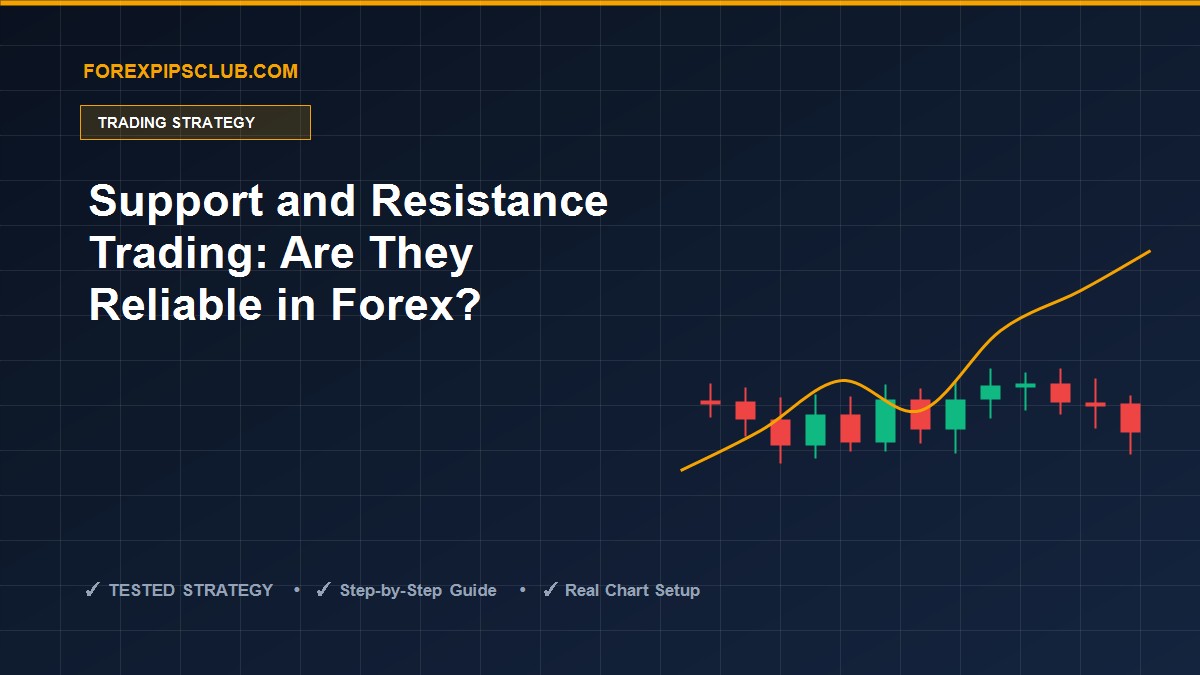
Forex trading is mainly the business of banks and financial institutions, and support and resistance give a sign of what these key players are doing in the market. Understanding support and resistance can help a trader get a clearer view of the market.
Prices in the forex market change with the weakness and strength of the related currencies. Several technical, fundamental, macroeconomic and socioeconomic factors affect currency prices. When the price of a currency pair changes, the movement leaves footprints and follows technical patterns. Smart traders look for those patterns to find potentially profitable trading positions with controlled risk, and support and resistance is the most common among them.

This article discusses the basics of support and resistance that every forex trader should know, the three best uses of support and resistance, and risk management tips.
Basics of support and resistance
The concept of support and resistance is controversial among traders. These levels are simply where price movement gets pushed back for a while or changes direction. The idea of identifying support and resistance may seem easy, but mastering it is different.
Support levels are where the price may stop falling for a specific period or start moving upward. Resistance levels are the opposite: where participants expect an uptrend to pause temporarily or where prices start to fall. Support and resistance occur mainly due to supply and demand for an asset, and also because of historical levels. In forex there is a common saying that "history repeats itself": prices bounce from certain levels because participants analyze historical price data as part of technical and fundamental analysis.
There are several ways to identify support and resistance, but professionals often use trendlines, moving averages and Fibonacci retracements. Price action traders see price movement differently and often identify these levels by following the accumulation and distribution phases of currency prices.
Another common fact is that when resistance breaks to the upside, it often acts as the next support level. Likewise, when support breaks to the downside with increasing selling pressure, it can act as the next resistance level. Traders often call these dynamic levels.
Why support and resistance levels may fail
The forex market is decentralized, and no one is in charge of the whole market. Nothing is absolute, as price movement depends on both currencies of a pair. Support and resistance levels also fail for several reasons, such as market sentiment, news (good or bad) and changes in supply and demand.
These levels also weaken when uncertain price movement is caused by major related events. Some false breakouts also happen, which often trigger traders’ stop losses.
The best use of support and resistance levels
Here are the three best uses of support and resistance.
Use with price action
Price action traders follow price movement by observing it in several ways and look to follow institutional price levels. Institutions often tend to buy assets at support levels and sell at resistance levels. As noted, resistance levels start to act as support after breaking, and support levels act as the next resistance.
When a resistance level flips into a support level, set the stop loss below the dynamic level. As long as the support and resistance remain intact, keep the stop loss outside the range.
Use with market context
Using support and resistance with market context is easy. When the price reaches a support level and bounces back every time, look to place buy orders at the support level with the initial stop loss below the support. Similarly, when the price reaches the resistance level, look to place sell orders with the initial stop loss above the resistance.
Follow the momentum
The last use is following momentum. Prices don’t fall in a straight line for long. Charts differ across timeframes: the current price movement may be downward on the hourly chart for a currency pair but upward on the weekly chart.
In a continuous downtrend, you can count the lower highs and lower lows along the support and resistance levels. Every time the price makes a new lower low or higher high, it bounces back or takes a break for a certain period before continuing in the same direction.
Risk management tips for support and resistance trading
Before placing any order using the support and resistance method, plan your trade carefully. Check how much of your capital is at risk and the expected return. Make a complete trading plan, including stop loss and take profit. Follow proper trade and money management. Try multi-timeframe analysis and match the price direction with your trade before opening it. You can also hedge using support and resistance, but practice and research more before applying a hedge to your trading account. A smart trader knows their exits before placing any order.
Final thought
Support and resistance levels are commonly used technical tools for any forex or stock trader. We suggest applying them on a practice account to get a clear concept before using them on your trading account. Also avoid trading, or be careful when placing orders, around major fundamental events such as interest rate decisions, GDP, GNP, job data and other trend-changing news releases.