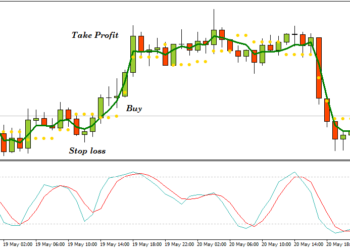

Trading in the financial market means executing trades with proper strategies. A proper strategy contains a complete trade setup, including entry and exit points. Successful traders follow trading techniques that set precise stop loss and take profit levels as a vital part of risk-reward management.
However, the financial market is vast, and no strategy guarantees profit every time. Defining exact take profit and stop loss levels can also confuse novice traders. This article defines these two vital factors and gives trading strategies that use them.
What are stop loss and take profit?
A stop loss is an advance order on a trading position that executes if the price moves against the position. Traders use it as part of risk management to reduce their risk. The financial market is volatile and no one knows the future direction for sure. Traders and investors use many technical and fundamental tools to find potential trading positions, and they use stop losses on their trades to protect their capital from adverse price movements.
Take profit (TP) is an advance instruction to exit an open order when the price reaches a certain level. Traders place TP at the level where they expect the price to go according to their strategy.
The stop loss defines how much risk you are willing to take on a trade, and the take profit represents its profit target.
How to use stop loss and take profit
Stop loss and take profit are mandatory for any trader who follows an approach with discipline. You can follow these steps:
Step one
Identify the potential trading position according to your trading strategy.
Step two
Execute your trade when your strategy suggests the most potential.
Step three
Set take profit and stop loss according to your trading strategy. This step comes last, but if you follow a proper strategy you will already know these levels at step one.
For example, suppose the XAU/USD price is near $1791. We draw a trendline on the H4 chart that suggests the price may bounce upward from here, so we may place a buy order. Our stop loss goes below the trendline, since according to our strategy the price should not break below it, and our take profit is just below $1850, which is a strong price action level and previous short-term support.
A short-term trading strategy
In our short-term strategy we use two EMA lines to generate trading ideas: an EMA 10 (blue) and an EMA 30 (red) crossover sort out entry and exit positions. The technique suits any timeframe; we recommend a 15-minute or H1 chart to catch short-term trades. Determine the long-term trend from higher timeframe charts and execute trades during the London and US sessions, as you will get sufficient volatility.
Bullish trade scenario
When the price creates a low and starts to bounce back, observe the EMA lines to look for buying opportunities.
Entry
Place a buy order when the blue EMA crosses above the red EMA and both lines head upward.
Stop loss
You can place an initial stop loss below the current swing low of the EMA crossover, which is an aggressive stop loss. For more safety, place the stop loss below the swing low where the uptrend begins, which is a conservative stop loss. A conservative stop loss keeps your position safer, but the reward relative to your risk won’t be as large as with an aggressive stop loss.
Take profit
This technique tends to generate trade ideas with at least a 1:2 risk-reward ratio. The initial profit target can be twice your stop loss distance. If you place a conservative stop loss, the ratio can be 1:1 or lower. Otherwise, you can close your trade when the blue EMA crosses below the red EMA.
Bearish trade scenario
When the price creates a high and declines, observe the EMA lines to look for sell opportunities.
Entry
When the blue EMA crosses below the red EMA, it signals a possible downward movement and a potential place for a sell order.
Stop loss
The initial stop loss goes above the current swing high where the EMA crossover occurs, which is an aggressive stop loss. You can place a conservative stop loss above the swing high where the downtrend begins for more safety.
Take profit
With an aggressive stop loss, your initial profit target is twice the distance of your stop loss, as this strategy suggests trade ideas with a 1:2 risk-reward ratio. With a conservative stop loss, the ratio can be 1:1 or lower. Otherwise, you can continue the sell order until the blue EMA crosses above the red EMA.
A long-term trading strategy
We use the golden crossover in our long-term strategy, with EMA 50 (green) and EMA 200 (red) lines to generate trade ideas. This strategy suits D1 charts.
Bullish trade scenario
Set the EMA lines on your target asset chart and look for buy orders when the price creates a swing low and starts bouncing upward.
Entry
When the green EMA crosses above the red EMA, it signals bullish pressure on the asset price. Place a buy order.
Stop loss
You can place an initial stop loss below the current swing low if you are comfortable with an aggressive stop loss. Otherwise, place a conservative stop loss below the swing low where the price starts making an uptrend.
Take profit
With an aggressive stop loss, the initial profit target is twice the stop loss distance above the entry, as this strategy suggests 1:2 risk-reward trades. Otherwise, close the buy order when the green EMA crosses below the red EMA.
Bearish trade scenario
When the price creates a valid swing high and starts to decline, observe the EMA lines.
Entry
Place a sell order when the green EMA crosses below the red EMA.
Stop loss
The initial stop loss goes above the recent swing high, which is an aggressive position. Above the swing high where the downtrend begins is the conservative position.
Take profit
With an aggressive stop loss, the initial profit target is twice the stop loss distance below the entry. Otherwise, close the sell order when the green EMA crosses above the red EMA.
Pros and cons
The top three pros of using stop loss and take profit are:
- They are essential elements of a complete trade setup.
- They let traders follow a disciplined trading approach.
- They reduce emotional trade decisions and help avoid overtrading.
If you don’t use them, the top three disadvantages are:
- You will always worry about open positions.
- You won’t create or follow a complete trading strategy.
- You won’t know how much you are risking on an open position.
Final thought
You now have a clear concept of the stop loss and take profit and their pros and cons. How much you risk depends on your trading strategy and style. For example, swing traders use aggressive stop losses, so their trades can have a risk-reward ratio of 1:3 or above, while a day trader may use a 1:2 ratio but take more frequent positions. The risk-reward ratio also affects the win rate of your trades. We suggest using stop loss and take profit wisely on every trade. In this way your capital will be safer, and it is the professional way to approach the market.